ZoneSteward: Cloudflare operations with a gate in front.
If you run many Cloudflare sites, you can ask what is happening in plain English and get alerted from real traffic. The AI proposes fixes and you approve each one.
- RoleProduct, architecture, design and engineering. Built alone.
- StatusPrivate beta, twenty seats, free until general availability
- StackNext.js, React, TypeScript, Node, SQLite, three.js, Claude API
- PlatformCloudflare GraphQL Analytics and REST APIs, self-hosted behind Cloudflare
- ScaleTens of thousands of lines of TypeScript, a large automated test suite and an evaluation harness with known answers
What it is
ZoneSteward is a web console for agencies and teams responsible for many Cloudflare zones across client accounts, usually ten or more they did not all build themselves. You connect your own Cloudflare API token and your own AI key. From there you can ask what is happening in plain English, watch traffic live, get alerted when something goes wrong, and fix it through an approval card instead of a dozen dashboards.
I run my own fleet through it every day. It started as the tool I wanted at work and became a multi-tenant product.
See what is happening
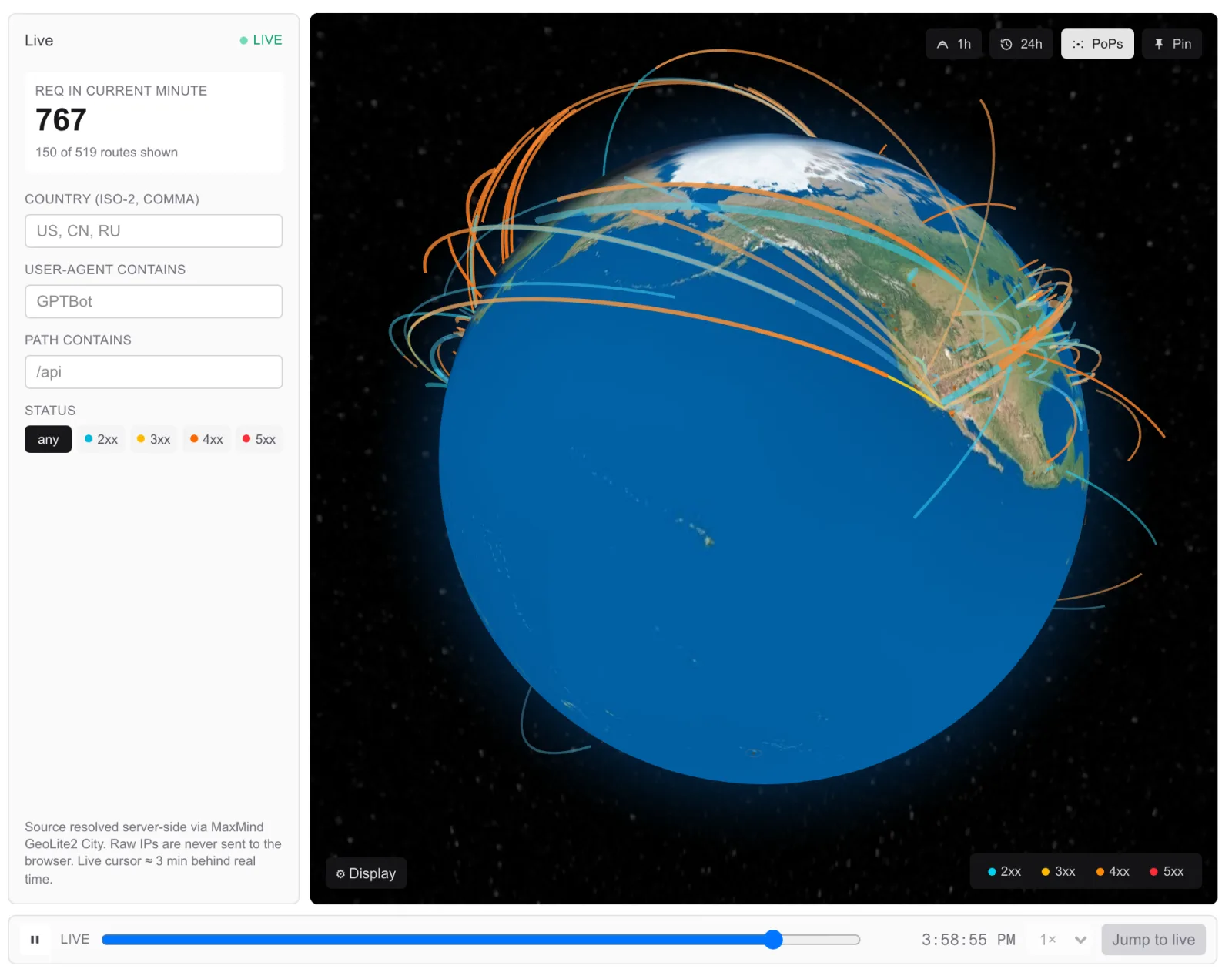
- A live 3D globe draws requests from where visitors are to the Cloudflare data centre that served them, over a rolling window, with a replay of the last day and a fleet view across every zone
- Live filters by country, user agent, path, status or host, with a side log of the actual requests
- A saved dashboard wall with about 27 widget types: requests, bandwidth, status split, top countries and ASNs, firewall events, bot traffic, attack feed, origin monitor, cache hit ratio, latency, incidents and more
- A library of flat and 3D chart types that the AI can suggest and you can save
- Google Analytics 4 read in beside the Cloudflare data, plus read-only panels for certificates, DNSSEC, Logpush, health checks, load balancers, waiting rooms, Turnstile, Workers routes and Access
Ask questions and get numbers you can trace
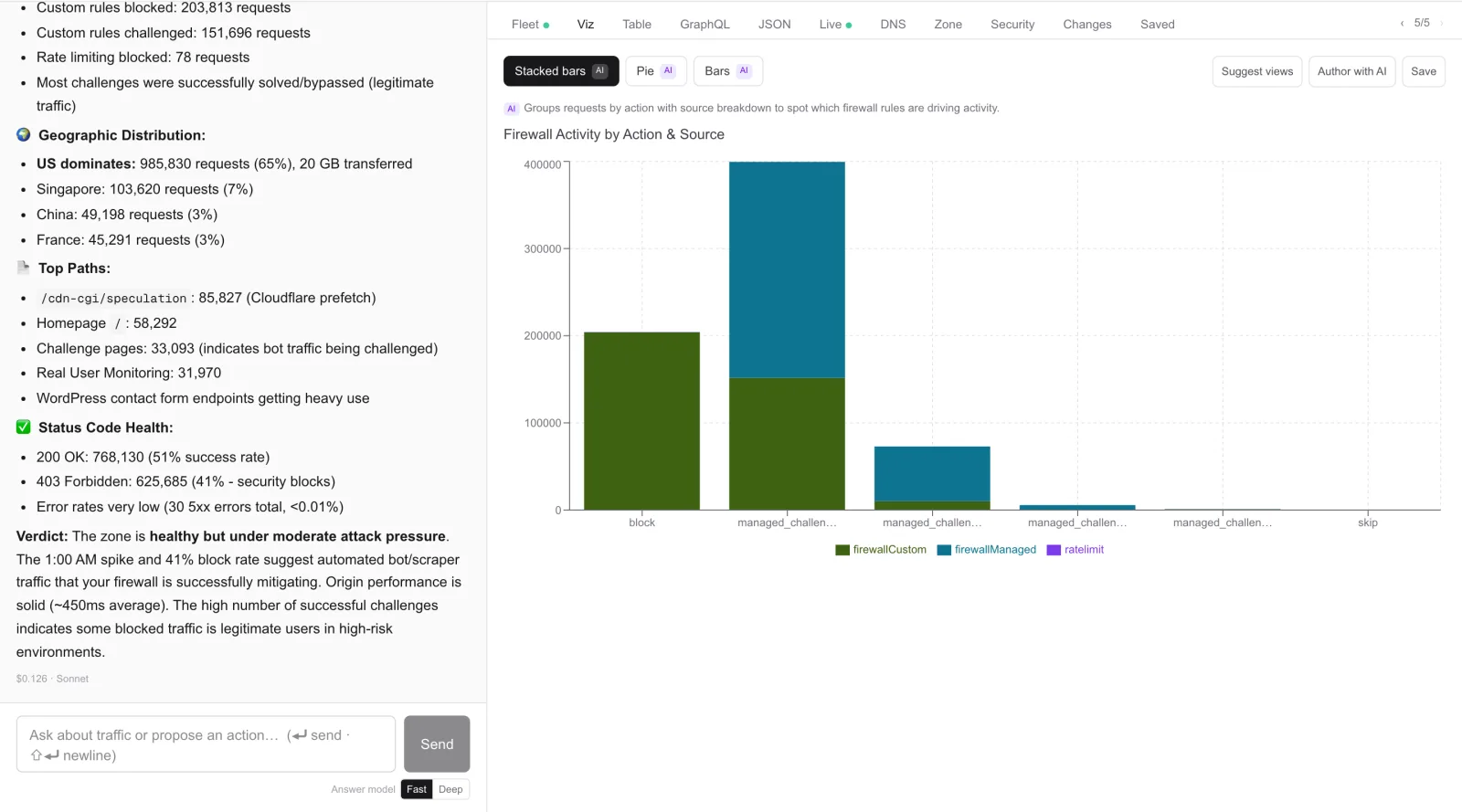
The chat has a large set of read tools. For a question like "who is attacking us?" or "why is this site slow in Germany?", the model writes a Cloudflare GraphQL query and the server computes the figures. The model is told to quote only server-computed numbers, and any figure in an answer that cannot be traced to one is flagged under the answer. On the last evaluation run every question was answered and nearly every figure traced back to the data.
- Attacker profiling into nine categories, from login brute force and CMS probing to SQL injection and credential stuffing, with a severity score and known crawlers cleared with a reason
- Per-attacker investigation that checks whether the same source is hitting your other zones
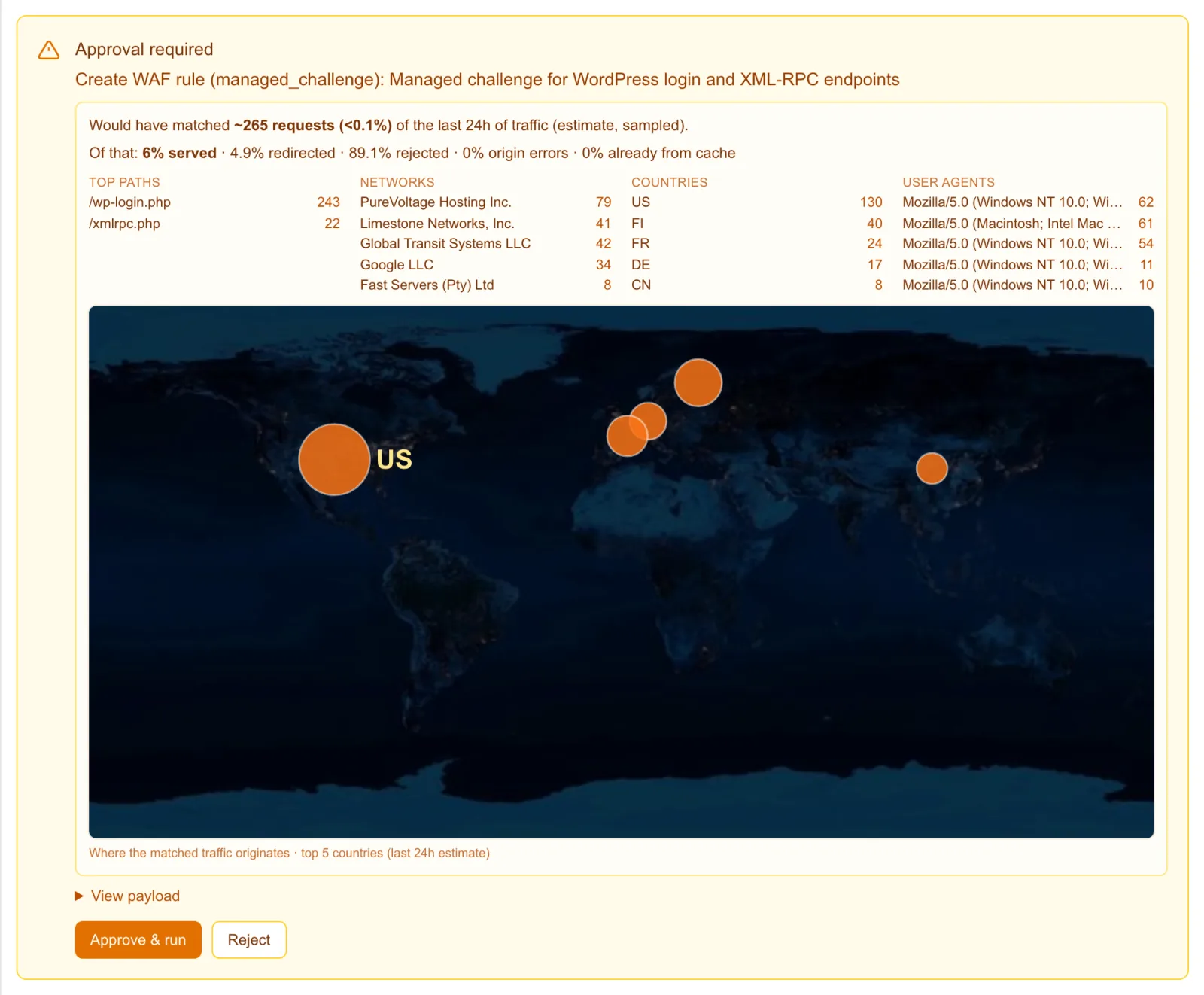
- A blast-radius preview that runs a proposed firewall rule against the last 24 hours of real traffic and warns when it would hit traffic that was being served, or good crawlers, or more than a fifth of all requests
- A question library of presets and saved questions
Alerts from real traffic
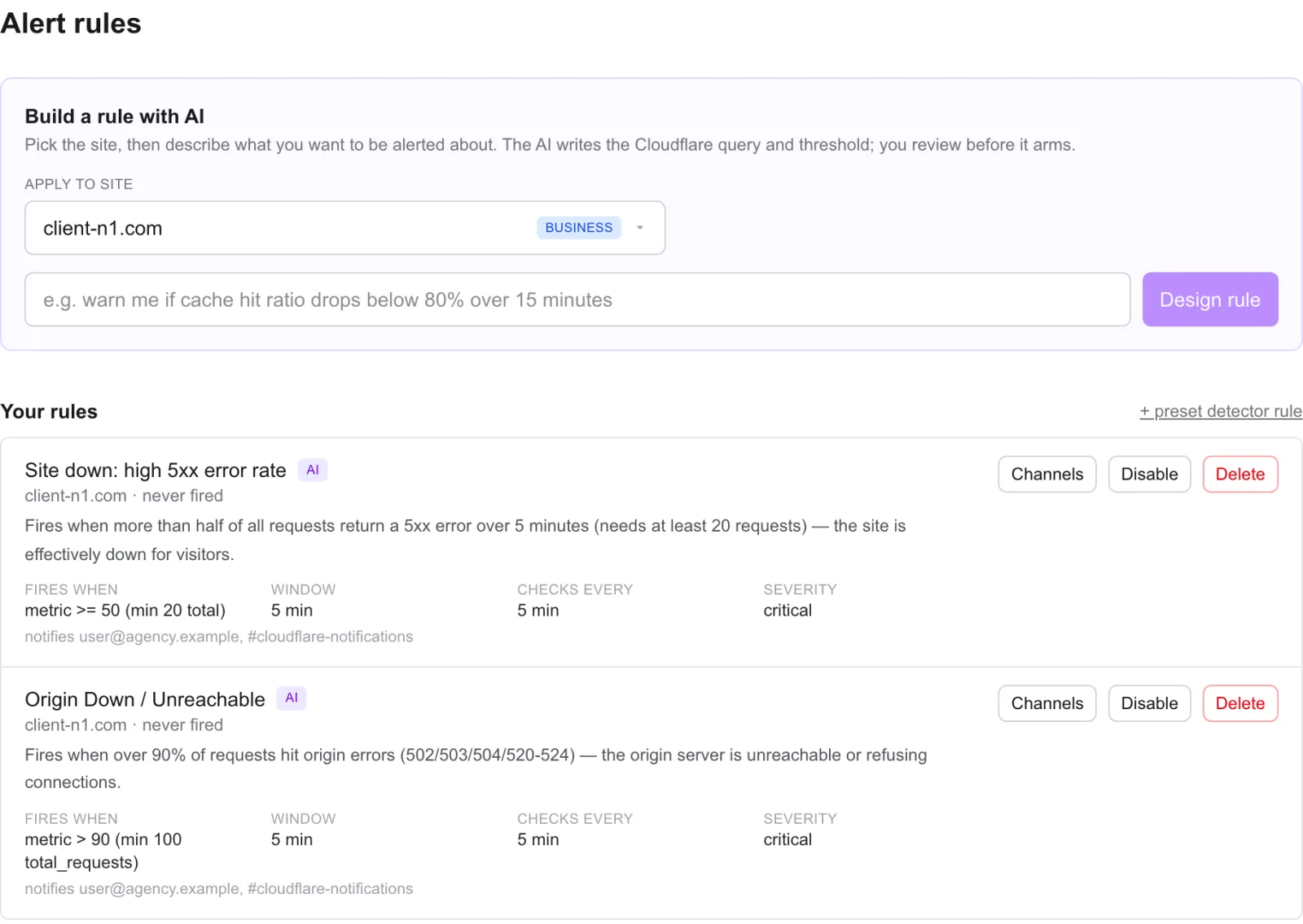
Alerts read the same analytics data the globe does. A shared poller keeps a recent buffer per workspace and built-in detectors run over it continuously, whether or not anyone is watching. Preset and custom rules run on their own schedule.
- Built-in detectors: 5xx error-rate spike, origin down, traffic drop or spike, 404 surge, geographic anomaly, and one ASN sending a flood of failed requests
- Presets: firewall block surge, cache hit ratio drop, origin p95 latency, and likely-bot surge on plans with Bot Management
- Custom rules written from a sentence: the model drafts the query, metric, threshold and window, dry-runs it against the live zone, and refuses to arm anything that does not reduce to a number
- Each incident gets an AI investigation before notifications go out, so the message arrives with a classification and a suggested fix that can become an approval card in one click
- Delivery to email, Slack, Microsoft Teams, SMS, PagerDuty and signed webhooks, each with a minimum severity, retries and a delivery record; plus an in-app stream and alert bell
- Incidents can be acknowledged, resolved or marked false positive, with cooldowns so one problem does not page you ten times
Changes with a gate in front
The model has no write tool. It can only propose. A proposal becomes a card that shows the impact and a preview; a person approves; the server re-reads the current state and refuses if anything moved; the change is applied and read back from Cloudflare; an audit row is written with the data needed to revert it in one click. The single automatic action, a managed challenge on one IP when a severe attack is detected, is off by default, opt-in per zone and capped.
- WAF custom rules, rate limits, cache rules and purges, redirects, rewrites, header rules, IP and country access rules, zone lockdowns, managed rulesets, zone settings such as SSL mode and minimum TLS, DNS records, health checks and waiting rooms
- Bulk apply across a zone group, with a separate acknowledgement once the change touches many zones
- High-impact changes such as a whole-site lockdown or an apex DNS deletion need an explicit acknowledgement; DNS and bulk changes are admin only
- Per-class write rate limits with an audited break-glass override
Governance and sharing
- Workspaces with owner, admin, user and viewer roles; sign-in by magic link, Google, Microsoft Entra ID or GitHub
- An audit log of every mutation attempt with actor, payload, Cloudflare's response and revert data
- Read-only share links for clients, pinned to one zone, revocable and time-limited; the link secret is never stored
- Printable zone and incident reports with CSV export, and a presentation mode that swaps real names for aliases so a workspace can be screenshotted
- Per-token capability model learned from real responses, never by writing; an AI spend log by feature and model; an email delivery log
How it is built
- Next.js and React on Node, with each workspace isolated in its own database and its own encryption key
- The globe runs on the GPU through three.js and react-three-fiber, light enough to stay smooth on a laptop
- The Cloudflare layer degrades by plan: denied fields are dropped and retried, time spans clamped, sampling reversed, free zones fall back to coarser data
- Any model provider: Anthropic, OpenAI or an OpenAI-compatible endpoint, with the customer's own key billed at cost
- Self-hosted behind Cloudflare with the origin sealed; encrypted off-site backups that are test-restored before the job reports success