The block universe theory as an interactive lesson, in your browser
Scroll and the argument builds, from time the way it feels to the claim that past, present and future all exist, with two observers slicing one block of spacetime and every tilt computed from tested relativity. Each stage says what kind of claim it is making. It is the second lesson I have built this way, and it shows what elearning content development can be when the subject is an argument and the model runs underneath.
Block Universe is a web page where scrolling builds an argument. It starts with time the way everyone lives it, one present moment sliding forward, and ends at the block universe theory, also called eternalism: the view that past, present and future are equally real, and that “now” is a position in the world the way “here” is. Between the two it works through tested relativity, one step at a time, and at the end it gives the people who reject the conclusion their turn. Two observers, amber and cyan, slice one block of spacetime at different angles all the way through. A dual clock in the corner keeps whatever comparison the stage is making, the home twin against the traveler, your now on Andromeda, a GPS clock against sea level, and every stage carries a chip saying what kind of claim it is: measured, established, an argument, open, or a metaphor. It is at block-universe.balian.dev. The Cosmic History post covered the stack and how a lesson like this lands in an LMS, so this one is about what changes when the subject is an argument instead of a history.
A spacetime diagram you can boost
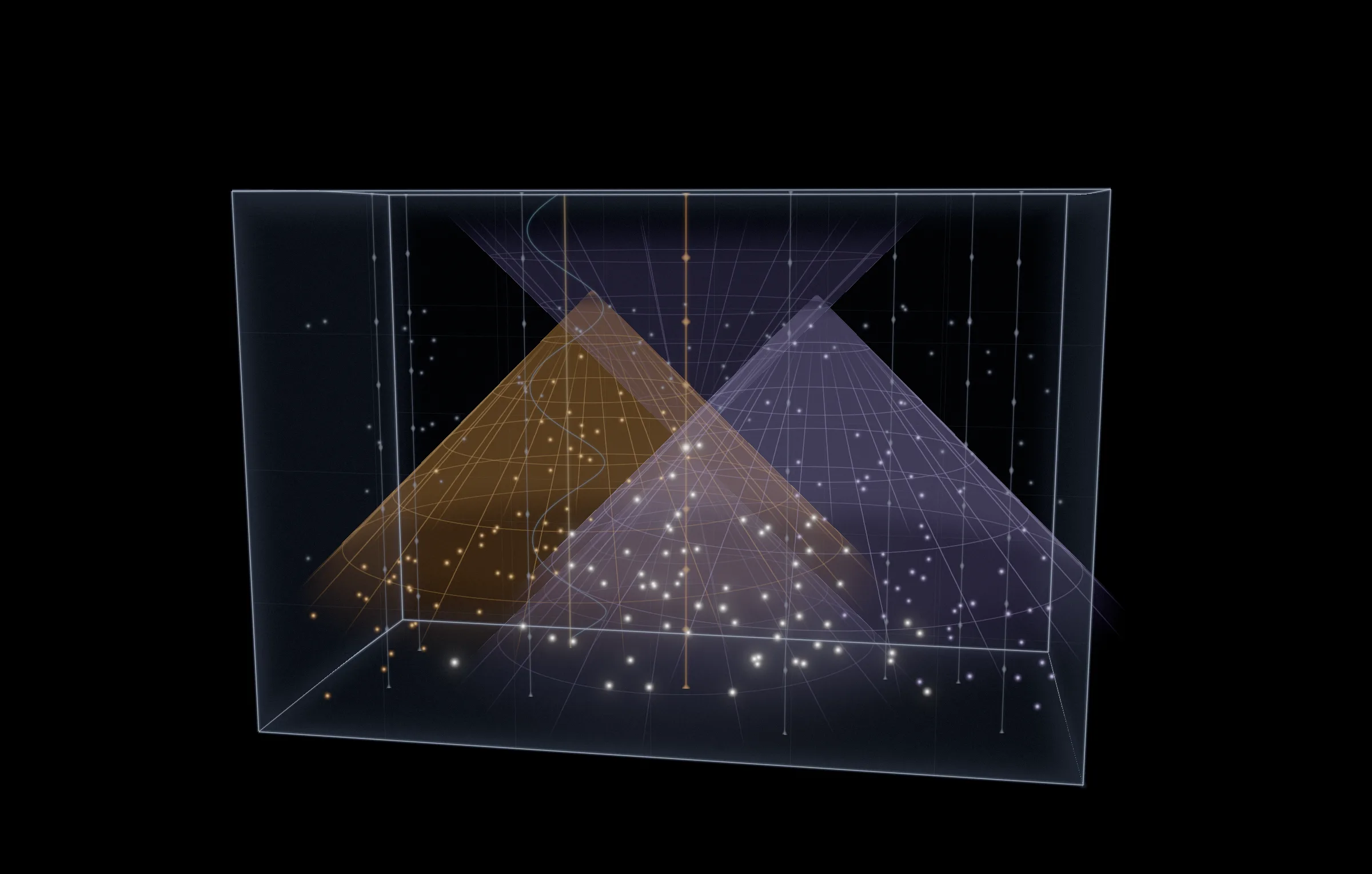
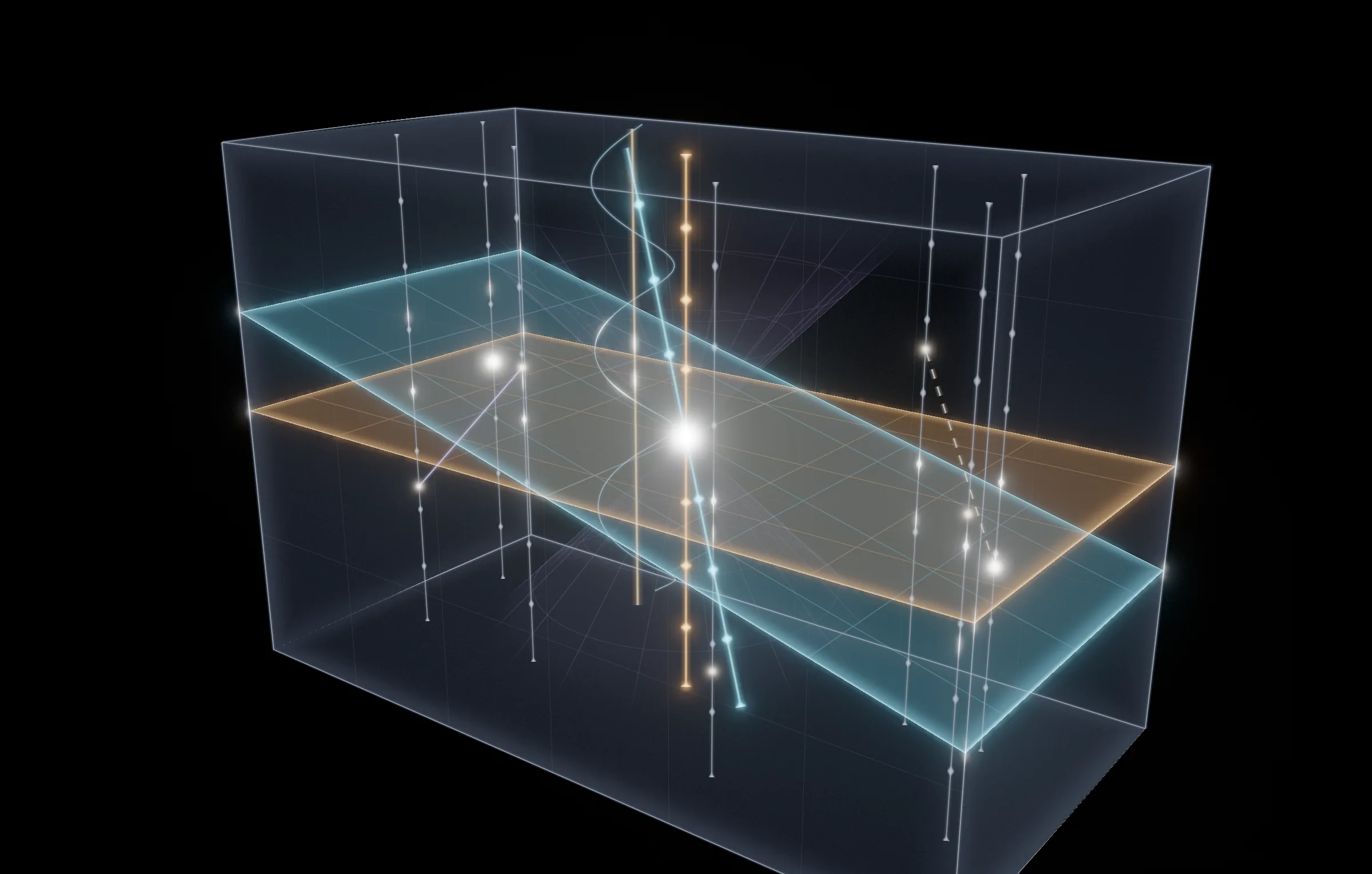
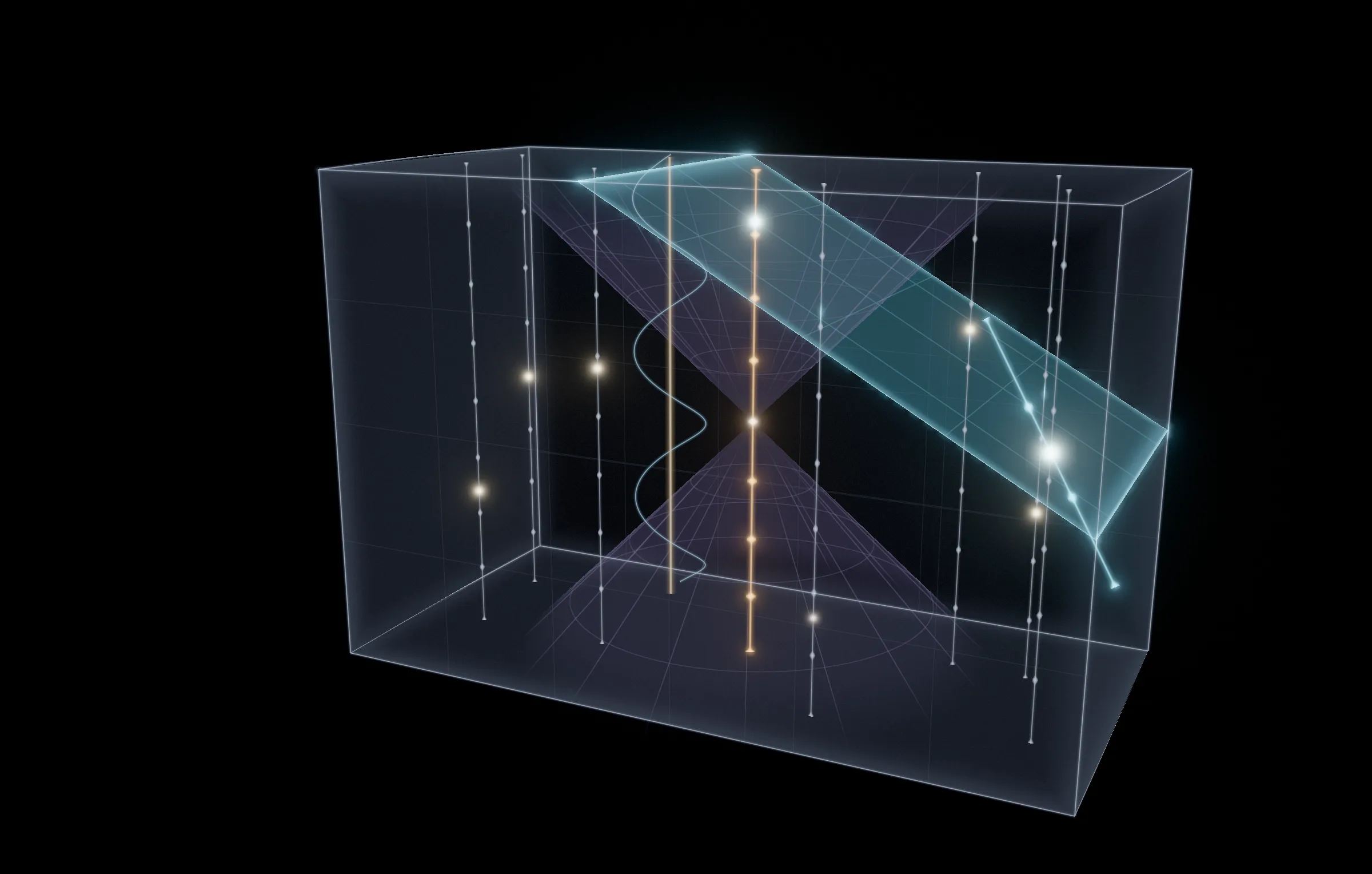
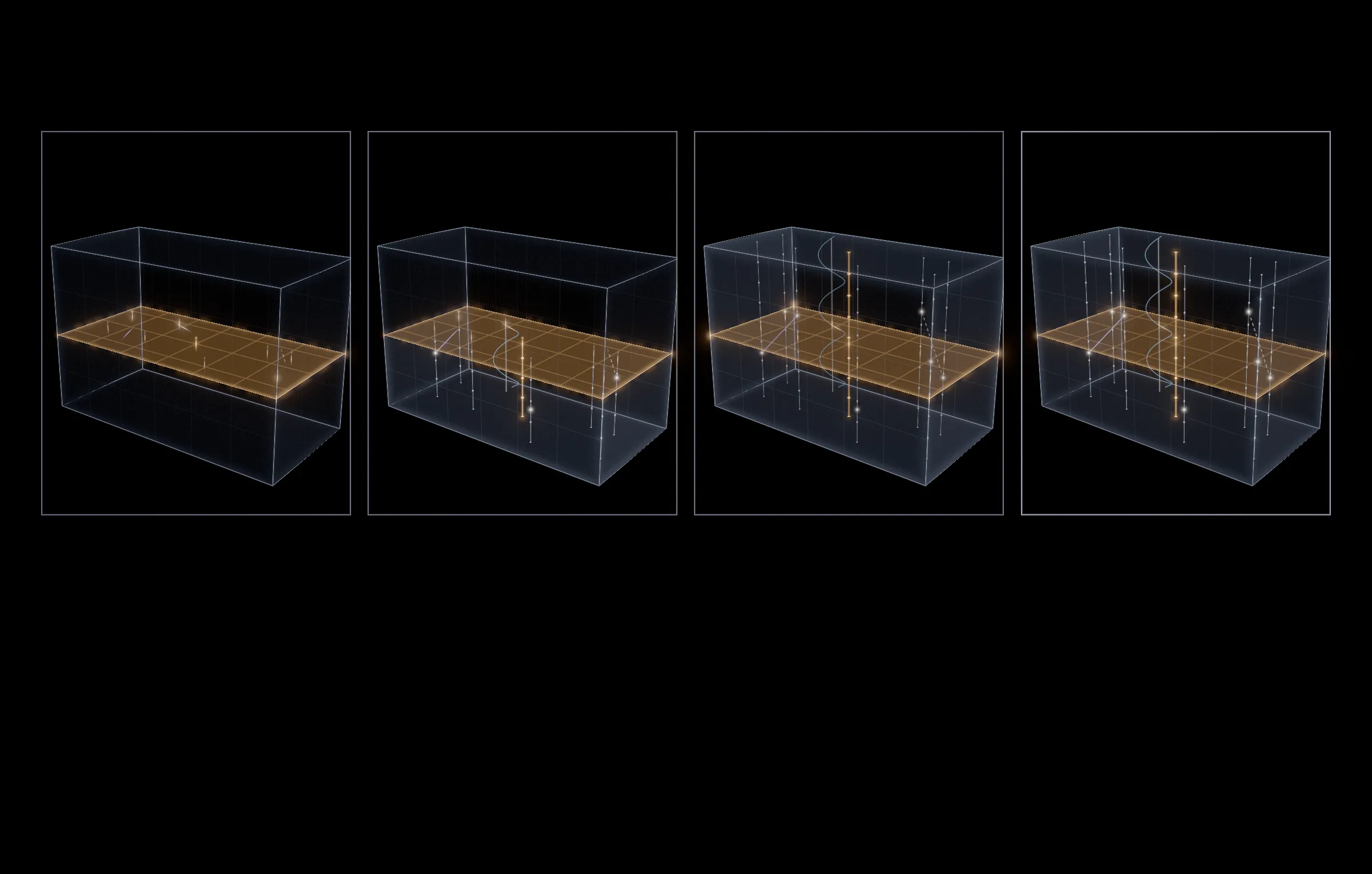
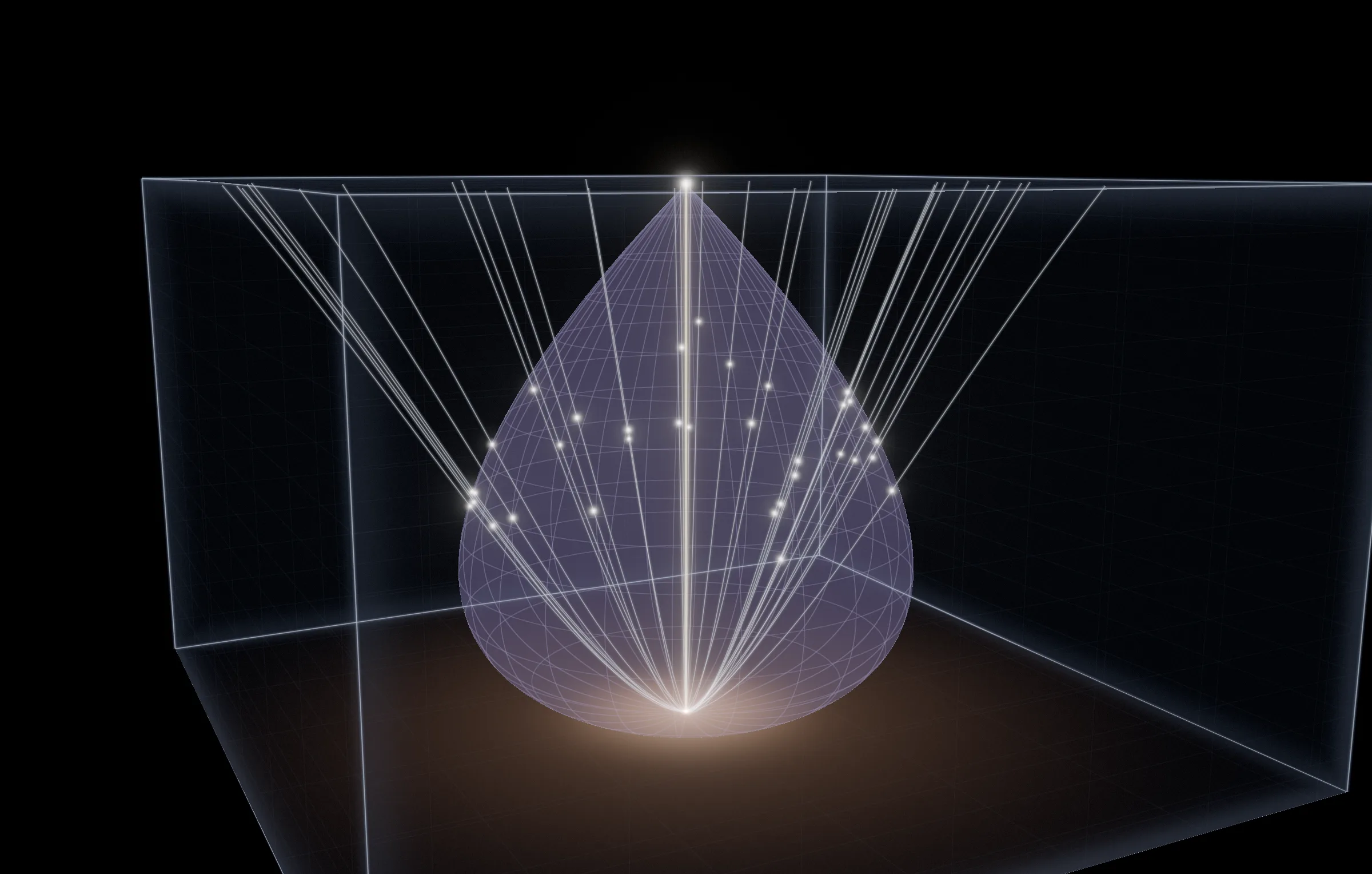
Every scene is a spacetime diagram, the kind drawn on a whiteboard with time running up, except that it has depth and the frame can be changed under it. One seeded set of worldlines and events is built when the page opens and used from the stacking stage to the end: the lamps the reader watches flash early on are the lamps the two knives light differently later, and the ones the fan of every possible now sweeps over near the end. Positions are stored as space and time, and every material runs them through a single view transform, a Lorentz boost followed by the loupe’s magnification, so changing one number leans every worldline and skews the grid while the light cones keep their shape. That is the physics, drawn by construction, because nothing in the code tells the cone to stay put. The two now-slices are glass sheets whose glow keeps a constant thickness in their own frame, worldlines are ribbons with a bead at every tick of their own clock, and labels are HTML anchored to points in the block, since text in a canvas cannot be read by a screen reader or selected.
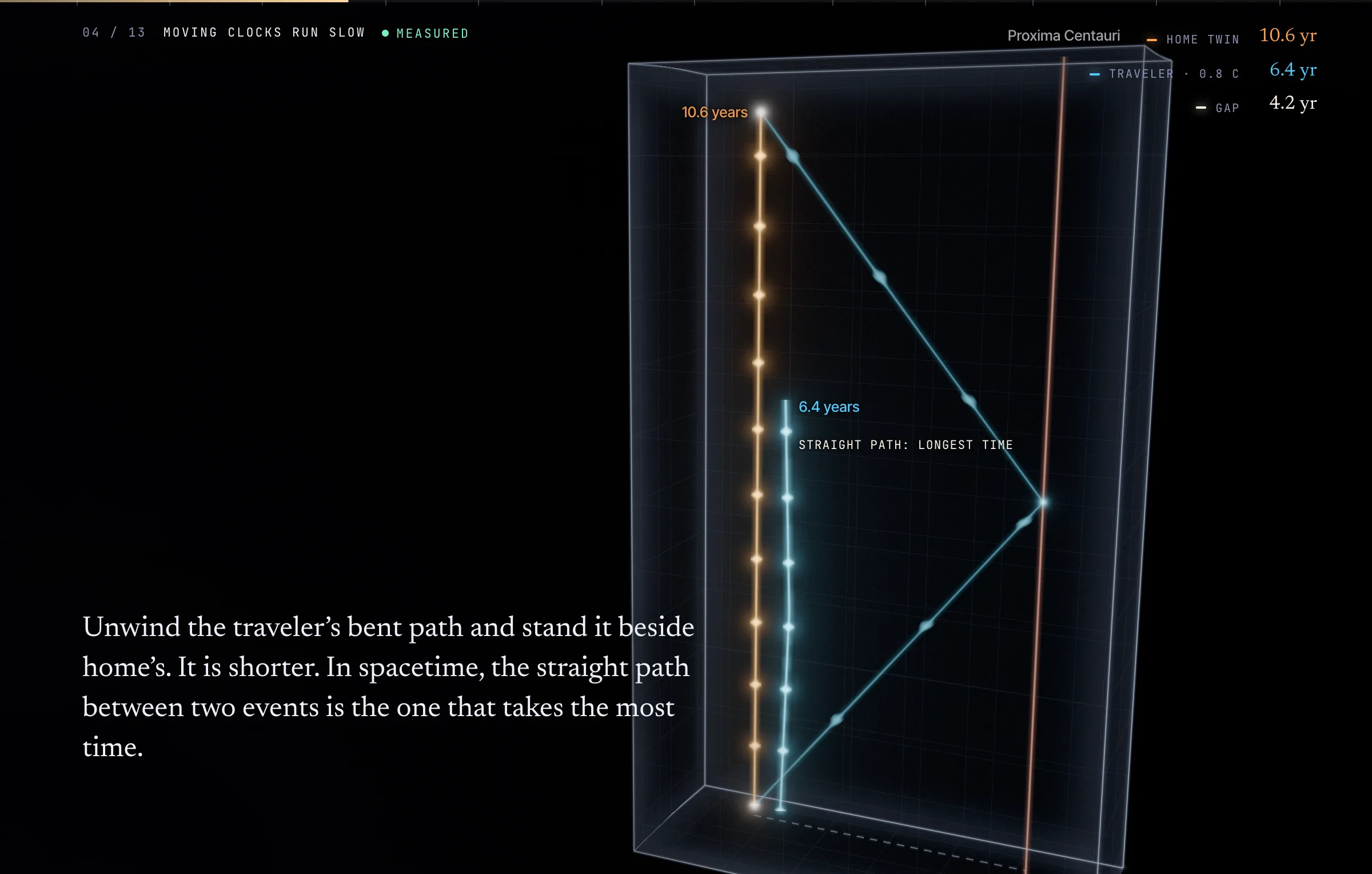
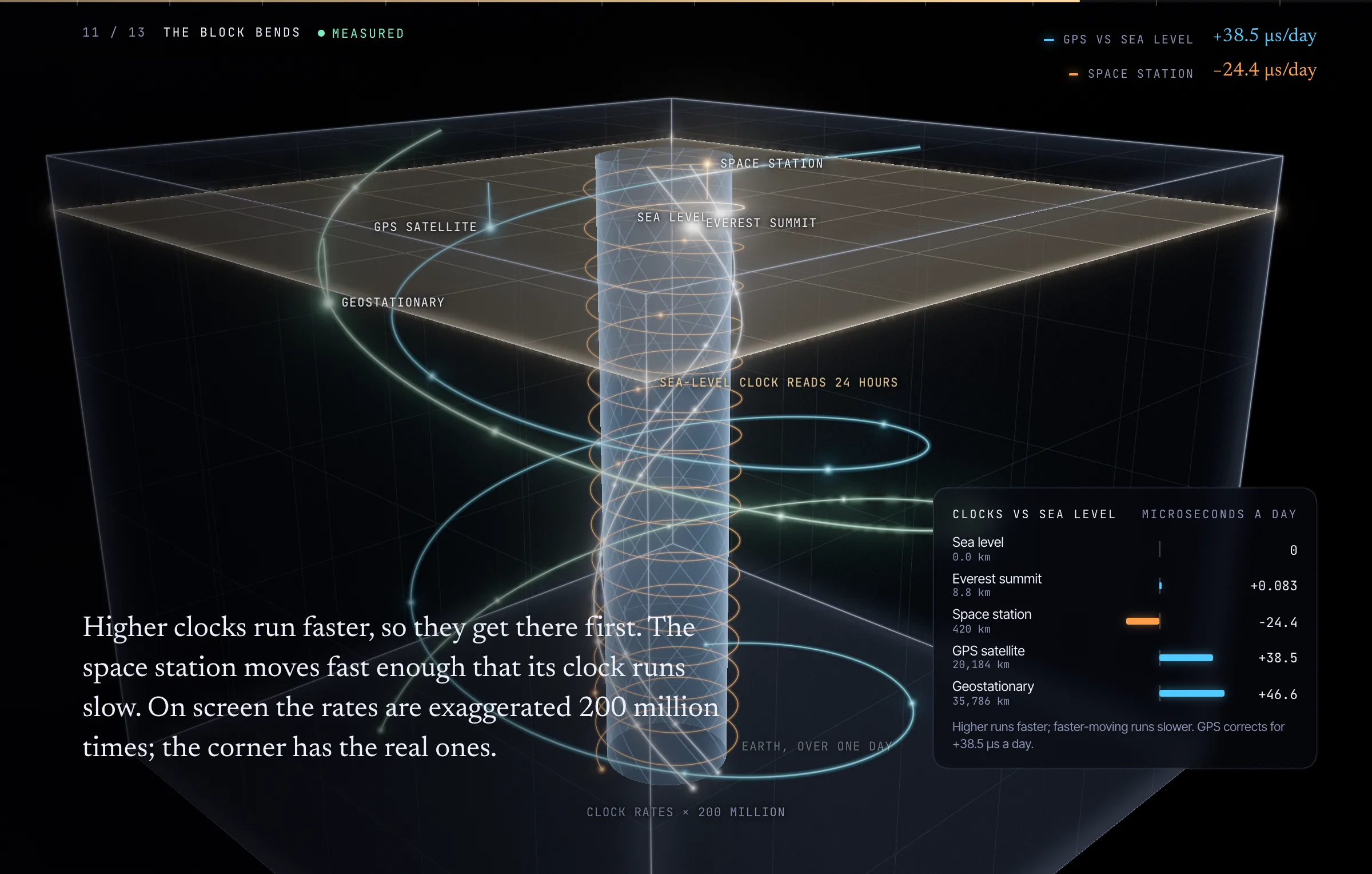
None of the numbers are typed into a scene. A relativity module in plain TypeScript, with its own tests, computes the twins’ ages, 10.62 years at home and 6.37 for the traveler to Proxima at 0.8c, the 38.5 microseconds a day a GPS clock gains, the half a microsecond your head gains on your feet over 80 years, and the shape of our past light cone back to the Big Bang, widest at 5.85 billion light-years, from the Planck 2018 parameters by the same code that runs Cosmic History. The scene and the readout in the corner call the same function, so the geometry on screen and the number beside it cannot disagree. Quality is automatic, the keyboard steps one caption at a time, reduced motion holds a frame per stage, and with no graphics card the page shows stills and the text still reads. After the journey there is an appendix with each stage’s “how we know” and sources, the experiments that measured the effects, and who argued what, from McTaggart in 1908 to Ellis in 2006.
The Andromeda paradox, at true scale
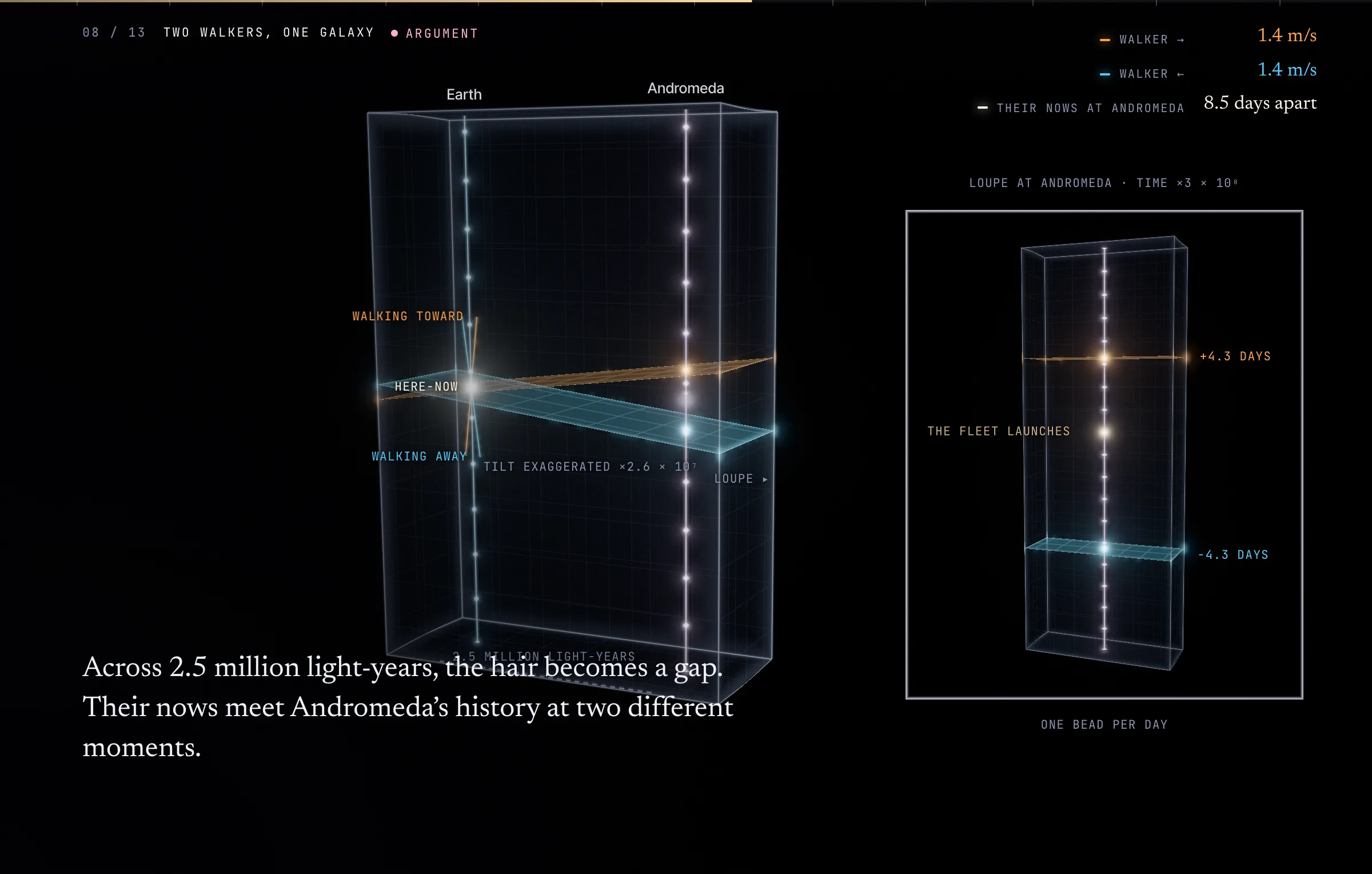
The stage I would show first is the one Roger Penrose made famous. Two people pass each other in the street, one walking toward Andromeda and one away. Their nows tilt by a hair, and over two and a half million light-years the hair opens into a gap: the one walking toward the galaxy counts a moment 4.3 days later as “now” on Andromeda than the one walking away. The page says the tilt on screen is exaggerated so you can see it, then puts a loupe at the far end at true scale with its factor on the bar. Penrose’s fleet launches on a day inside the gap, already departed for one walker and still undecided for the other. Let the walkers move at any speed and the window on Andromeda’s history opens to two and a half million years either way, right to the edge of the light cone, and a table in the corner gives the same width for the Moon, the Sun, Proxima and out to the Virgo Cluster.
The relativity of simultaneity in one picture
What the page is careful about is the line between the physics and the conclusion. The relativity of simultaneity is established: it follows from light having one speed for everyone, which has been measured since 1887, and the same transformations predict the muon lifetimes and clock drifts the earlier stages show as measured. The step from there to “the future already exists” is the Rietdijk-Putnam argument, and the page labels it an argument, names its premises, and then lets Howard Stein’s 1968 reply and the rival views, presentism, the growing block, the moving spotlight and George Ellis’s crystallising block, stand side by side in four panels under the chip “open”. The same page says measured about the muons at CERN and open about whether your future is already there.
Where it exaggerates, and says so
The walkers’ tilt is exaggerated on screen and the caption says so before anything else. The clock rates around Earth are exaggerated two hundred million times so the beads visibly separate, with the real values, the space station losing 24.4 microseconds a day and a geostationary clock gaining 46.6, in a table in the corner. The rotor in the rolling shutter stage spins far faster than any rotor could, so that its blades bend visibly in the moving observer’s photograph. The orbits in the stacking stage are out of scale. Each of those is in the stage’s note, which is in the HTML as well as in the picture.
Elearning content development with a model underneath
A history is easy to teach badly and still get something across, because the order carries the learner. An argument is harder. The learner has to hold two frames at once and see which claims are measured and which are inferred, and a slide deck flattens all of that into bullet points that look equally true. A lesson built this way can let the learner lean the frame and watch the order of distant events change while cause and effect stay put, and can label every claim by kind, which is most of the job when the subject is an argument.
What your expert edits
Each stage of this lesson is a plain file with a title, a summary, the captions in order, a “how we know” paragraph, the sources, and its status. The engine never touches them. For your subject your expert would write those files and I would build the scenes under them, and a change in the wording, or a new source, is an edit to a text file.
Elearning development services that land in your LMS
The packaging is the same as for Cosmic History: SCORM 1.2 or 2004, or xAPI, so completion, progress and the answers to any checks arrive in your LMS or learning record store, LTI 1.3 for Canvas, Moodle, Blackboard and D2L, and an embed for the rest, with checks and branching between stages. The Cosmic History post has the full LMS section.
Subjects that are arguments
A regulation with two defensible readings, a clinical decision where the guidelines weigh against each other, a financial product under two interest rate paths, a safety case where the same data supports two procedures, a physics or philosophy unit at a university that ends in a live question. The common thread is a learner who has to hold two frames at once and know which of the facts in front of them are settled.
A lesson with live relativity, 3D, tests and accessibility used to need a studio and a season. This one was built by one engineer in a fraction of that time, because I build with AI, and that is what makes the price fit a training budget. It is a fixed price for a written scope, with the subject, the stages and the LMS connection priced before anything starts. The AI-assisted engineering page says how I work and what I check.
Tell me the subject your people argue about and I will tell you what a lesson like this would take. Cosmic History is the first lesson, and the data visualization and 3D page has what I would build for a company.