Custom elearning development: the history of the universe as an interactive lesson
Scroll and the universe goes by, from a fraction of a second after the beginning to today, with the real cosmology running underneath and every stage saying how much to trust it. I built it as a lesson, and it is what custom elearning development looks like when I do it for your LMS.
Cosmic History is a web page where scrolling moves you through time, from a fraction of a second after the beginning to today. A caption explains each stage as you reach it, a clock in the corner keeps the age of the universe and its temperature, and every stage says how much to trust what you are looking at: measured, simulated, modelled, or a metaphor where nobody knows. It is at cosmic-history.balian.dev. I built it as a lesson, and I am showing it here because it is the clearest example I have of custom elearning development: what is under it, what it cost to make, and what the same build would do for a subject your people have to learn.
Interactive elearning with the real numbers underneath
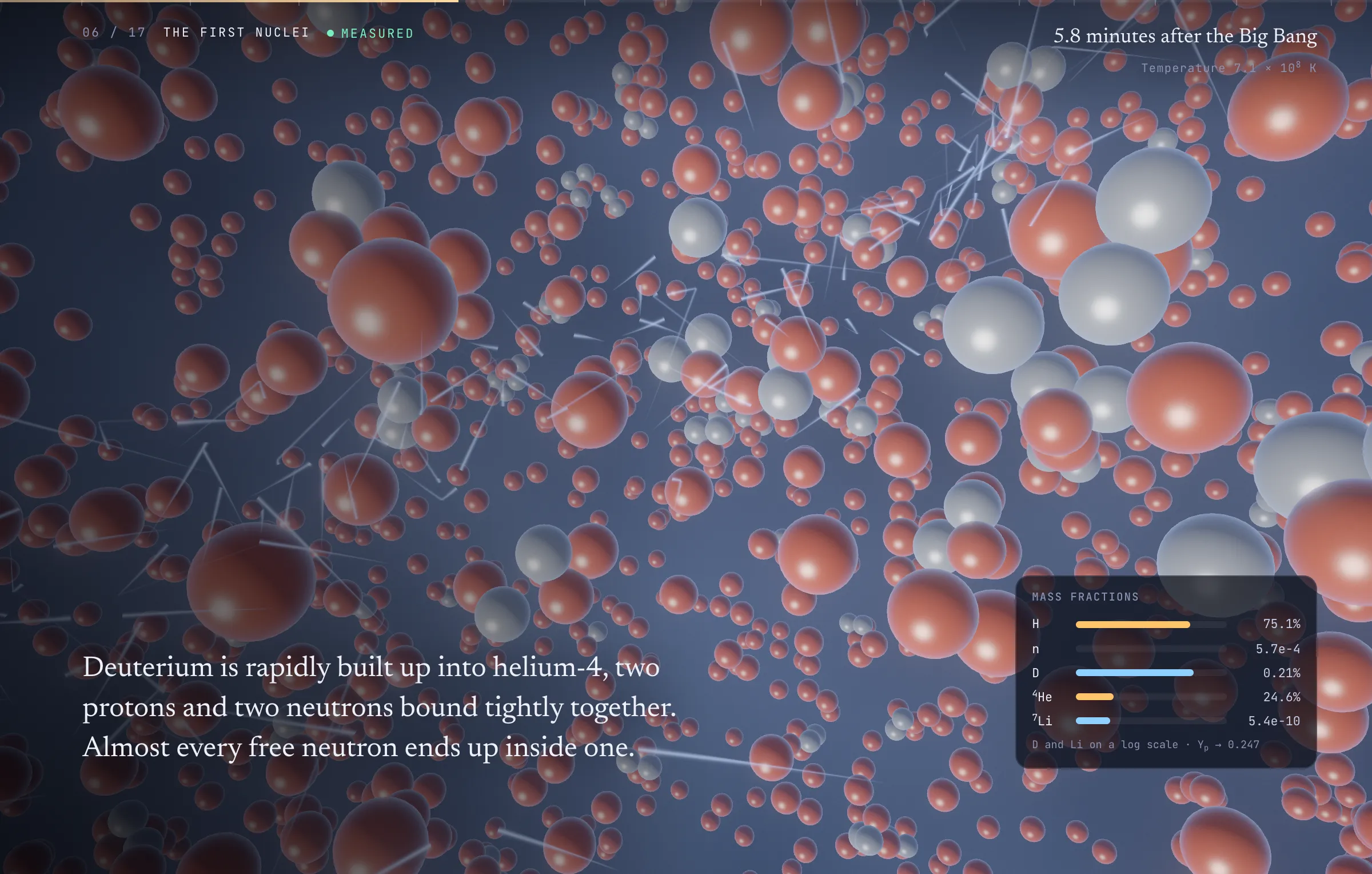
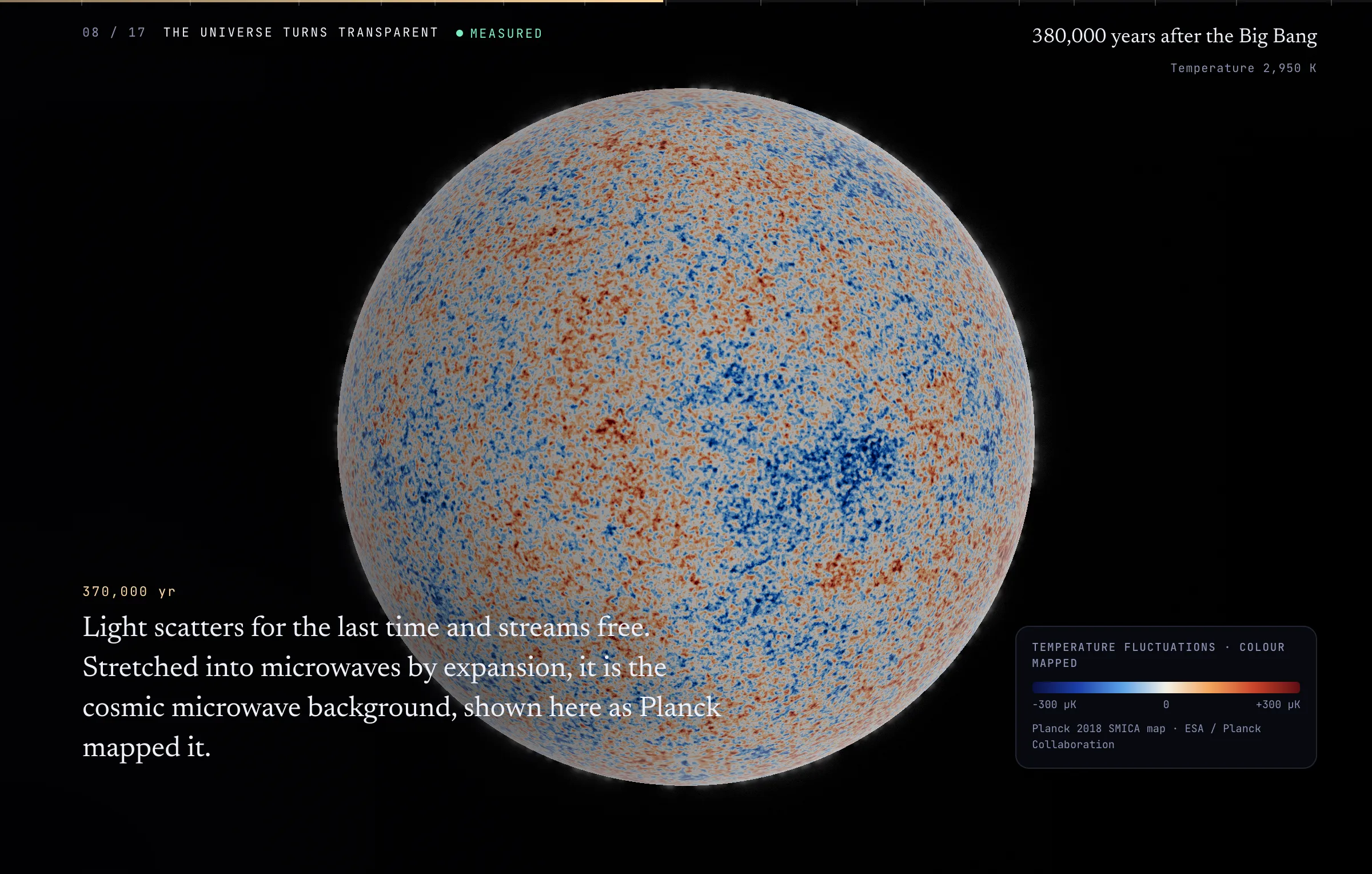
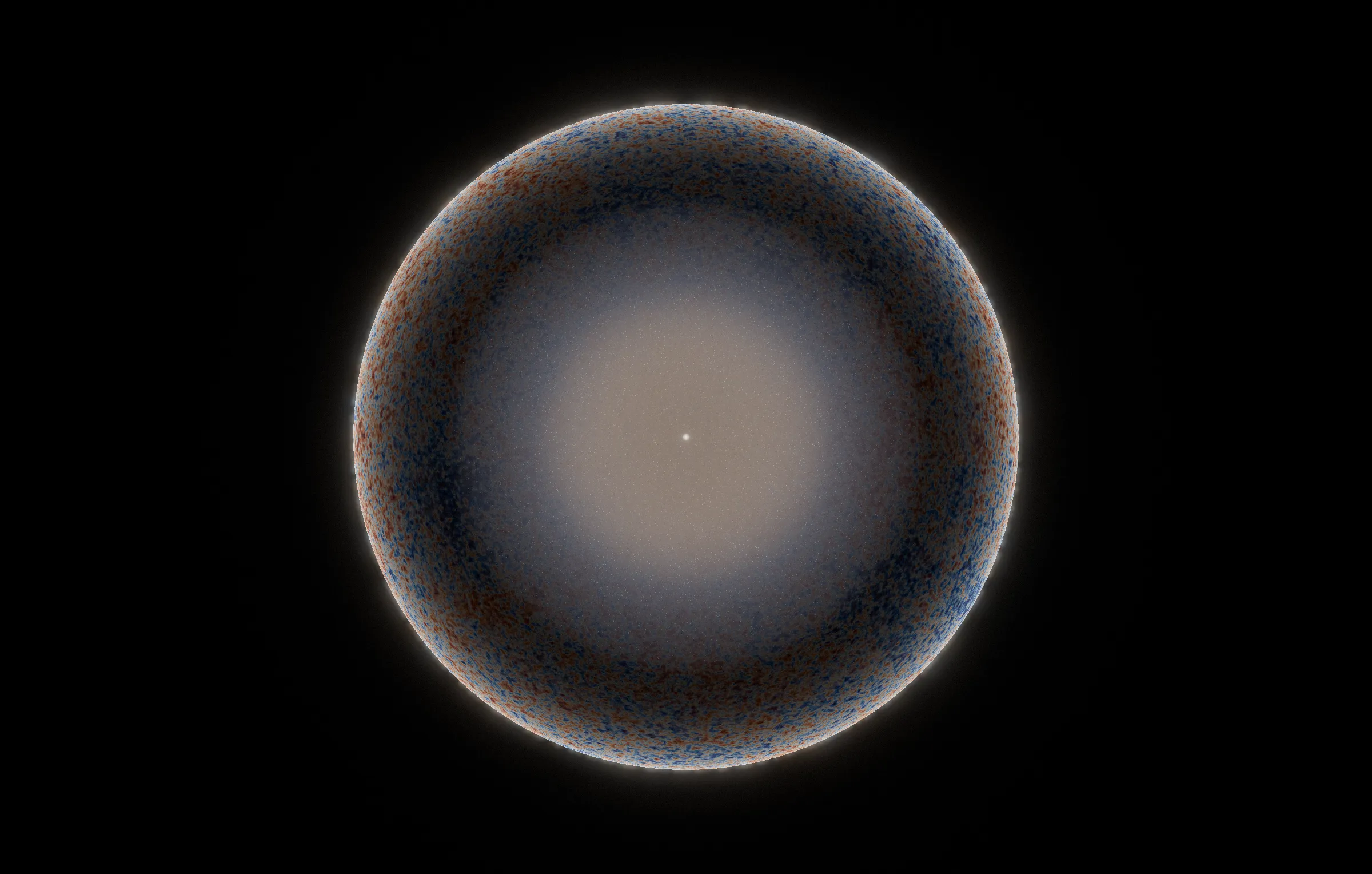
The age of the universe is not typed in anywhere. The page takes the parameters the Planck mission published in 2018 and, when it loads, integrates the equation that governs the expansion of a flat universe into a table of age against size. The age is read off that table and comes out at 13.79 billion years, which is the figure in the paper. The moment the early fog clears comes out at 371,000 years the same way. Each frame, the current size, redshift and temperature are handed to the graphics card and the shaders draw from them, so if a parameter changed, everything on screen would change with it. The formation of the first nuclei, the thinning of the fog, the burning away of the hydrogen haze by the first galaxies, the rate of star formation and the colour of a hot gas each have their own small piece of code with tests, and the gauges on screen read from them while you scroll. The speckled sphere at the moment the universe turns transparent is the map Planck made of the microwave sky.
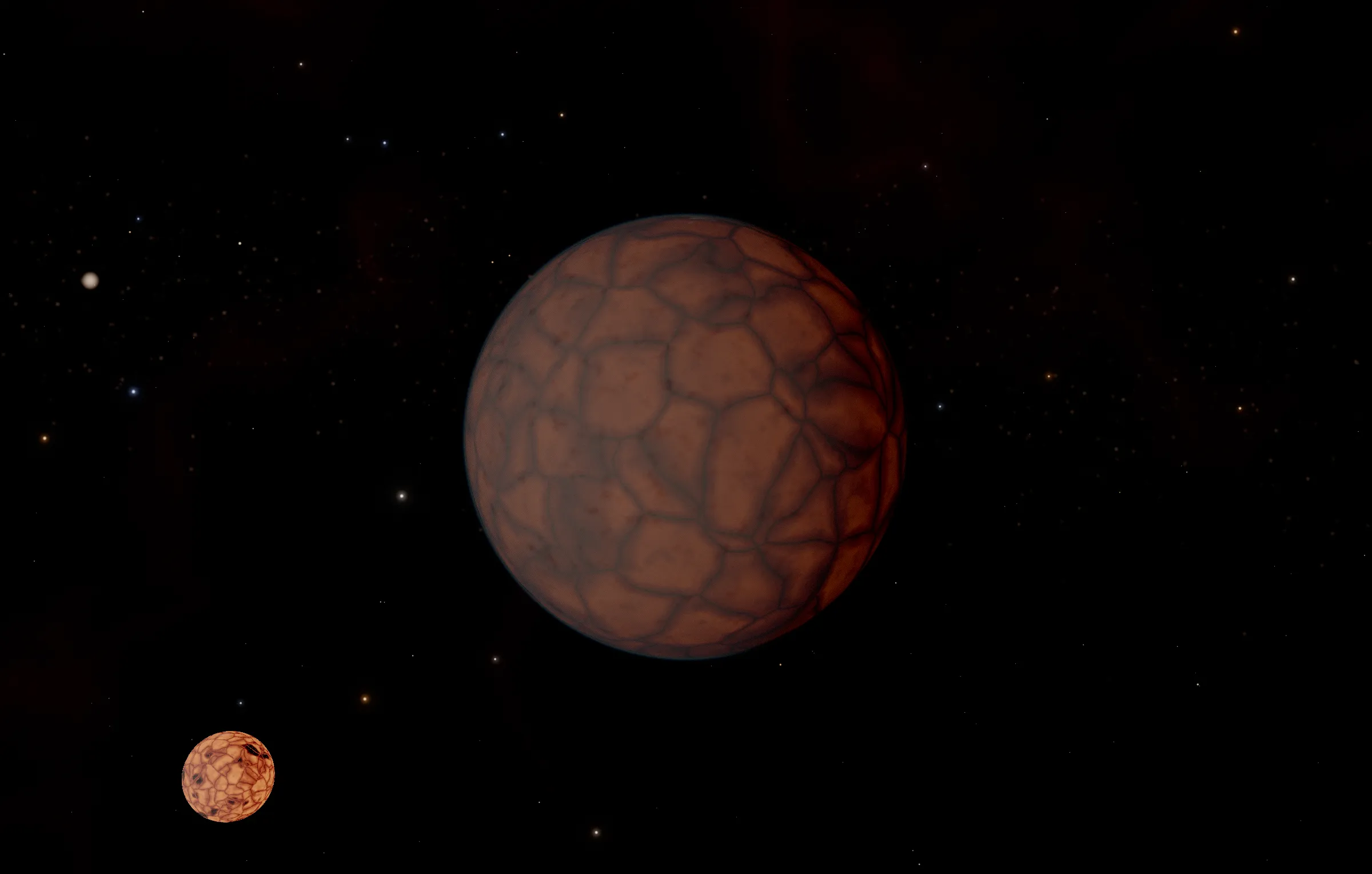
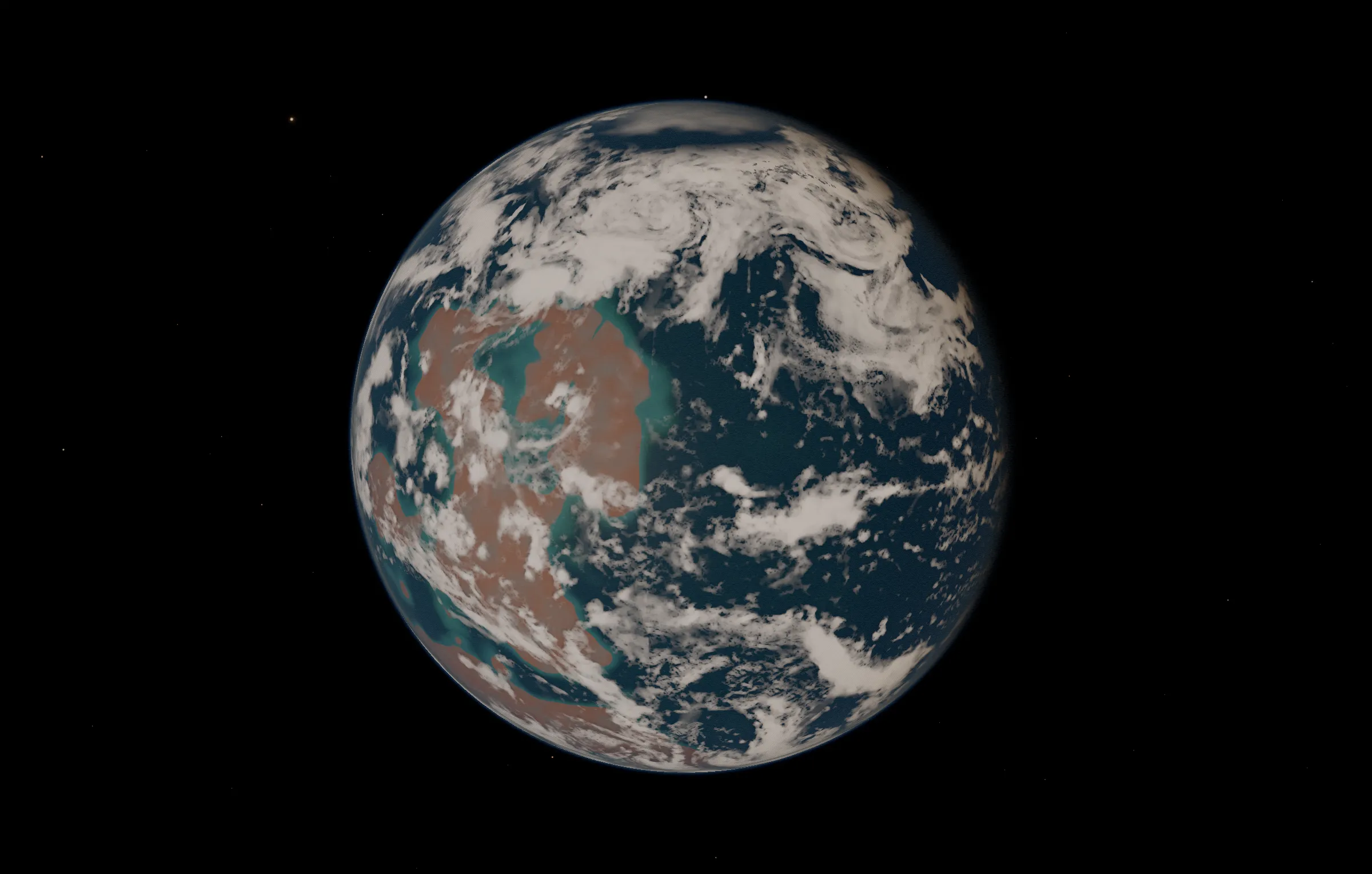
The structure is one universe all the way through. When the page opens it builds a single random field of the ripples inflation left behind, from one seed, in a background thread. That field gives the ripples you watch during inflation, the lumps of matter afterwards, and the pull that draws those lumps into sheets and filaments. The web of filaments that grows during the dark ages is the one the first stars light up later, and the one the camera pulls back through at the end. A phone gets a coarser version of the same field, so it sees the same universe with less detail. Particles are not stored anywhere. Each one is placed by the graphics card from the seed, the scroll position and the time, which is what lets you scroll backwards and watch the whole thing come apart. The fog, the foam, the cloud that collapses into the Sun and the haze around the first galaxies are drawn as volumes, which costs more than flat sprites and looks like the thing.



The elearning development stack
It is built on Astro and TypeScript. The rendering is three.js on WebGPU, falling back to WebGL2 where a browser lacks it, with the shaders written once in three’s node language so the same source runs on both. Lenis handles the scrolling and a Cloudflare Worker serves the files. When the page opens it guesses a quality level from the device, draws a one-second test at full resolution, and drops a level if frames take more than 22 milliseconds. The lowest level draws 60,000 particles and the highest a million. With no graphics acceleration at all you get pre-rendered stills that crossfade from stage to stage, and the captions still read. The full text is in the page in order for screen readers, stage changes are announced, the arrow keys move one caption at a time, and with reduced motion on each stage holds a single frame.
Where the lesson simplifies, and says so
Some of it is exaggerated on purpose. After matter and antimatter annihilate, about one particle in a billion survives. The demo shows one in fifty, because one in a billion is a black screen. Galaxies are drawn about forty times too large. The first stars burn far longer than they did. The first stage, before any tested physics, is labelled a metaphor, and its caption says so before anything else. I would rather someone who knows the field finds the label before they find the exaggeration.
Custom elearning development for your LMS
Most online training is slides with a Next button and a quiz at the end, and anyone who has taken one knows how much of it they kept. A lesson built the way this one is built is a page the learner moves through at their own pace, with a working model of the subject under it, on a phone, with a screen reader if they use one.
Custom elearning content your expert can edit
For a client I would keep the subject matter in plain files your expert can edit, a title, a span, the captions in order, how we know, the sources, with the engine untouched underneath. Checks and branching go between stages. It is in your brand and you own the files.
SCORM, xAPI and LTI, so it lands in the LMS you already run
I would package the lesson as a SCORM 1.2 or 2004 object, or as xAPI, so completion, progress, time spent and the answers to any checks arrive in your LMS or your learning record store. Canvas, Moodle, Blackboard and D2L connect over LTI 1.3. LearnDash, Thinkific, TalentLMS and the others take an embed.
Subjects that suit interactive elearning
The subject could be a machine your technicians service, taken apart as you scroll, a process your operators run with the real set points driving the picture, the compliance topic nobody reads the PDF for, anatomy, a financial product, or a safety procedure that is currently a laminated card. If there is a model behind the subject, the model can run under the lesson.
What custom elearning development costs now
A lesson with real physics, 3D, tests and accessibility used to need a studio and a season. This one was built by one engineer in a fraction of that time, because I build with AI, and that is what makes the price fit a training budget. Like everything else I do, it is a fixed price for a written scope, and the proposal says what the subject, the number of stages and the LMS connection add up to before anything starts. The AI-assisted engineering page says how I work and what I check.
Tell me the subject your people struggle to learn and I will tell you what a lesson like this one would take. The rose engine and the watch movement are the other two demos, and the data visualization and 3D page has what I would build for a company.